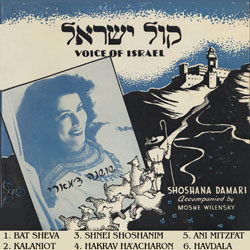
Shoshana Damari was born in Yemen in 1923 and brought to Palestine by her parents as a toddler. As a young child she joined her mother as she entertained at family gatherings and community events. By the age of 14 Shoshana was already performing regularly on the radio.
Her exotic beauty, along with her distinctive husky voice and Yemenite accent brought a uniquely Middle Eastern flavor to mainstream Israeli music which had previously been totally dominated by Eastern European influences.Read More About This…
Now you can celebrate the 4th of July and your Jewish heritage at the same time.
This new compilation of songs from the Judaica Sound Archives at Florida Atlantic University Libraries in Boca Raton, FL is about the American Jewish experience.
It contains Yiddish songs recorded during the early 20th century and expresses a Jewish immigrant perspective on New York, Coney Island and other things distinctly American.Read More About This…
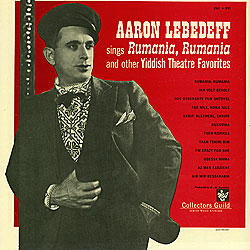
Album Cover of Aaron Lebedeff Sings Rumania, Rumania and more
Aaron Lebedeff was a Yiddish theater super star whose popularity among Jews during the 1920s and 1930s made his name a household word. More than 80 years before performers could go viral on the internet, Lebedeff was making a name for himself by driving audiences wild with his energetic and exuberant live performances. He was a super-star, like Mick Jagger, who was able to excite audiences and leave them wanting more.
His devil-may-care free spirit, love of life and allusions to sensual delights helped to create his exciting persona. Whether dressed in traditional Russian garb and boots or formal attire with straw hat and cane, his dynamic presence always kept him the center of attention. He understood nostalgia for the shtetl and was able use it to rouse his audiences’ emotions. His best known recording,Roumania, Roumania, was originally released in 1925. His second version, recorded with Sholem Secunda and Dave Tarras in 1941, became a best-selling Yiddish recording during the 1940s and still brings a smile to almost everyone who hears it!Read More About This…
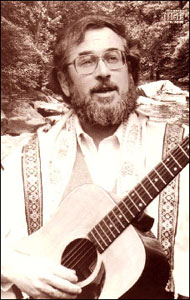
Rabbi/Cantor David Shneyer is a singer-composer, guitarist, and clarinetist . He grew up in Lakewood, New Jersey. After graduating from Rutgers University in 1970 Shneyer moved to Washington, D.C. Along with fiddler Alan Oresky he created new Jewish liturgical folk music and founded the popular folk and klezmer band the Fabrangen Fiddlers in 1971. This group remains devoted to the rediscovery of Jewish folk music and the development of new Jewish liturgical folk music.
Sometimes known as a Human Rights Rabbi he is the director of AmKolel Sanctuary and Renewal Center in Pikesville MD.Read More About This…
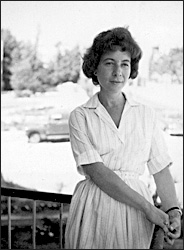
Gladys Gewirtz touched the lives of thousands of people who never met her. Her recordings were among the first that were digitized and played on the JSA website (www.fau.edu/jsa). Over 60 years ago, Gladys Gewirtz, had the idea of creating recordings for young Jewish children. Together with her sister, Roz Grossman who wrote the lyrics and patter between songs, she produced recordings based on familiar fairy tales and nursery rhymes. The simple sing-along tunes are endearing and bring back early childhood memories to many listeners.
Gladys attended Julliard and Columbia University. She was music director of the first Camp Ramah, and taught at the Jewish Theological Seminary where she inspired a generation of music teachers and counselors.Read More About This…

 Comments (1)