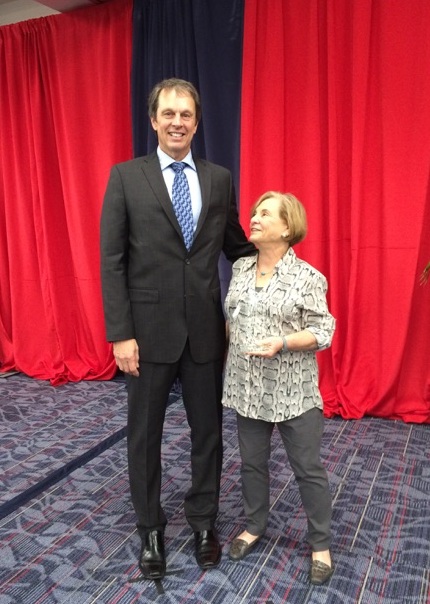
FAU President Dr.John Kelly presented Maxine this prestigious award on April 22, 2015.
Maxine was nominated for the prestigious Jeffrey Gabor Exemplary Employee Award by Rita Pellen, Interim Dean of FAU Libraries. In her nomination letter Pellen praised Schackman for her hard work building up the Judaica Sound Archives since the early 2000’s.
In 2009, when she stepped in as director, Schackman expanded the scope of the online archives by including rare historic vintage and jazz recordings.Read More About This…
‘Lincoln: The Constitution and the Civil War’ Exhibition
Friday, March 20 – Thursday, April 30
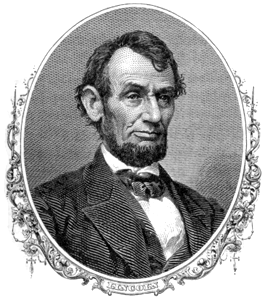
Florida Atlantic University will host “Lincoln: The Constitution and the Civil War,” a traveling exhibition from the National Constitution Center, from Friday, March 20 through Thursday, April 30 at the Wimberly Library, 777 Glades Road, Boca Raton campus. The exhibition features photographic reproductions of original documents, including a draft of President Abraham Lincoln’s first inaugural speech, the Emancipation Proclamation and the Thirteenth Amendment. “Read More About This…
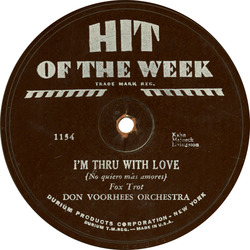
Introduced in 1930 and discontinued in 1932, these records were made from a flexible synthetic resin (Durium) coasted on brown paper.
What are sound recordings made of?
Initially sound was recorded on wax cylinders. By the end of the 1920s, however, recordings were made of a heavy, fragile shellac compound.
Producers began looking for better options and started experimenting with materials that were lighter, flexible and less fragile.
One of these experiments, Hit of the Week records, were actually made of resin coated brown paper! This lightweight, flexible, “unbreakable” composition was unique and provided a 78 rpm recording with sound equal to or better than ordinary shellac.Read More About This…
The Second World War waged around the globe from 1939 to 1945.
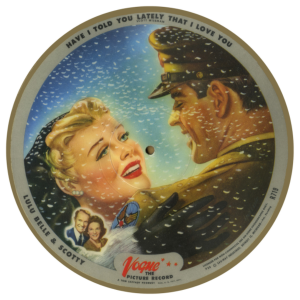
The impact of WWII on the daily lives of Americans and Europeans cannot be overstated. As the atrocities of the Nazis raged in Europe, American men were drafted and called to war. American music of the WWII era spoke to the soldiers far from home and also to those they left behind.Read More About This…
RSA’s sound technician, Ben Roth, set up a table and tried to entice passersby to sign up at Boca Pointe’s Volunteer Fair on Tuesday, January 20, 2015. Not much luck.
People are often amazed at the number of recordings that the RSA has been able to digitize and put online. “How do you do it?” That’s a question we often hear.Read More About This…

 Comments (0)